
Solar Batteries
What is a Solar Battery?
A solar battery stores the excess electricity your panels generate during the day so you can use it at night instead of buying it back from the grid. In Perth, where Synergy’s standard tariff is 32.37 cents per kWh but daytime solar exports earn as little as 2 cents per kWh, the financial case for battery storage is stronger than almost anywhere else in Australia.
This page covers everything Perth homeowners need to know before buying a solar battery in 2026, how they work, which brands Middle Swan Solar installs, what they cost after rebates, how to size the right system for your home, and when a battery does and doesn’t make sense.

Why Solar Batteries Make Sense in Perth
Perth’s electricity market creates a specific financial dynamic that makes battery storage particularly compelling.
Under Synergy’s Distributed Energy Buyback Scheme, solar electricity exported to the grid earns just 2 cents per kWh during off-peak hours and 10 cents per kWh during the peak window of 3pm to 9pm. But every unit of electricity you import from the grid costs 32.37 cents. That gap, between what you earn exporting and what you pay importing, is where a battery earns its return.
A 10 kWh battery cycled daily shifts approximately $3 of additional value per day, around $1,095 per year, by substituting grid electricity at 32.37 cents with stored solar that would otherwise have earned 2 cents on export.
Perth also averages 5.5–5.8 peak sun hours per day, among the highest in Australia. Most Perth homes with a 6.6kW system generate more electricity than they can use during daylight hours. A battery captures that surplus rather than exporting it at minimal return.
Solar Batteries Middle Swan Solar Installs
Middle Swan Solar installs a curated range of premium battery systems. We don’t offer every brand on the market, we install the ones we trust to perform reliably in Perth’s climate over the long term.
Enphase IQ Battery 5P
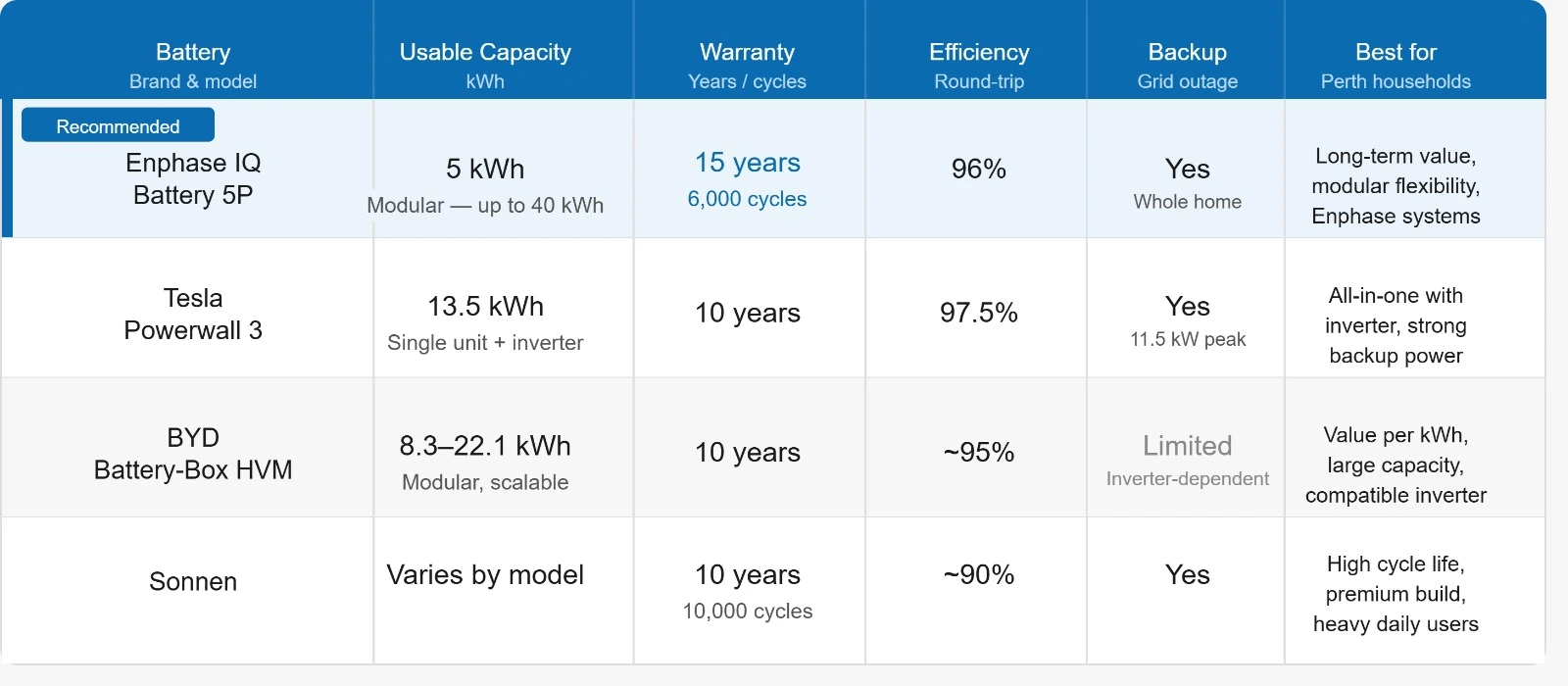
The Enphase IQ Battery 5P is our most recommended residential battery for most Perth homes. Unlike competing batteries which use a central inverter, each 5 kWh Enphase module has four built-in microinverters, eliminating a single point of failure.
Key specifications:
- Usable capacity: 5 kWh per module, stackable up to 40 kWh
- Round-trip efficiency: 96%
- Warranty: 15 years or 6,000 cycles, the longest of any mainstream battery in Australia
- Chemistry: Lithium Iron Phosphate (LFP), safer and more heat-tolerant than NMC
- Backup capability: Yes, with IQ System Controller
Why it suits Perth: LFP chemistry handles high temperatures significantly better than older NMC chemistries. Perth’s regular 40°C+ summer days accelerate degradation in less thermally stable batteries; the IQ 5P’s chemistry and 15-year warranty give Perth homeowners the strongest long-term coverage available.
Pricing: A single 5 kWh system typically costs $7,000–$9,000 installed after the federal rebate. A 10 kWh system (two modules) runs $12,000–$15,000 installed after rebates.
See also: Enphase battery installation cost guide
Tesla Powerwall 3
The Tesla Powerwall 3 is the most recognisable home battery in Australia and one of the strongest all-in-one solutions available. Its key differentiator is a built-in hybrid solar inverter, most competing batteries require a separate inverter to be purchased and installed alongside them.
Key specifications:
- Usable capacity: 13.5 kWh
- On-grid power output: 10 kW continuous
- Backup power output: 11.5 kW peak
- Round-trip efficiency: 97.5%
- Solar input: Up to 20 kW via 3 x MPPT inputs
- Warranty: 10 years
- Chemistry: Lithium
- Iron Phosphate (LFP)
Pricing: A fully installed Powerwall 3 in Perth typically costs $13,500–$15,200 before rebates. After the federal rebate (~$3,367) and WA Residential Battery Scheme rebate ($1,300), most Perth households pay approximately $10,000–$11,800.
See also: Tesla Powerwall 3 price guide
BYD Battery-Box Premium HVM
BYD is one of the world’s largest battery manufacturers. Their Battery-Box Premium HVM range is a modular high-voltage battery compatible with a wide range of hybrid inverters.
Key specifications:
- Module size: 2.76 kWh per module, stackable from 8.3 kWh to 22.1 kWh
- Chemistry: Lithium Iron Phosphate (LFP)
- Warranty: 10 years, 80% capacity retention
- Inverter compatibility: Sungrow, GoodWe, Fronius GEN24+, SolarEdge
- Backup capability: Limited, depends on inverter configuration
Why it suits Perth: BYD’s strongest advantage is value per kWh. After the federal rebate, installed cost lands around $550–$850 per usable kWh, cheaper per kWh than the Tesla Powerwall 3. For Perth homeowners whose primary goal is bill reduction rather than backup power, and who already have a compatible hybrid inverter, BYD is the strongest value proposition.
Pricing: A BYD HVM 16.6 kWh costs roughly $12,000–$16,000 installed before rebates, or approximately $8,100–$12,100 after the federal battery rebate, assuming a compatible hybrid inverter is already in place.
Note: BYD batteries cannot pair with Enphase micro inverters or the Tesla Powerwall’s integrated inverter. We’ll advise at quote stage whether your existing inverter is compatible.
Sonnen Battery
Current Rebates Available in Perth — 2026
Federal Cheaper Home Batteries Program
Launched 1 July 2025, this program provides approximately 30% off the installed cost of eligible batteries. The rebate is applied by your installer at point of sale. Eligible batteries must have a capacity of 5–100 kWh and be installed with rooftop solar (new or existing). For a 10 kWh system the current rebate is approximately $2,500–$3,500 depending on system size and configuration.
WA Residential Battery Scheme
Synergy customers are eligible for a $1,300 rebate on approved battery installations. Horizon Power customers in regional WA can access $3,800. This rebate stacks on top of the federal program.
Combined rebate: Most Perth metro households can access $3,800–$4,800 in combined rebates on a 10 kWh battery system. Combined support can reach $5,000–$7,500 for some eligible households depending on system size.
See also: Solar Battery Cost Perth guide for full pricing, rebate breakdown and quote comparison tips.
How to Size a Battery for Your Perth Home
The right battery size depends on your evening electricity consumption, the energy your household uses between sunset and when you go to sleep.
Rough sizing guide for Perth homes:
- Small households (1–2 people, basic appliances): 5 kWh
- Average households (3–4 people, standard appliances): 10 kWh
- Large households or heavy users (ducted aircon, pool, EV): 13.5–20 kWh
Perth-specific sizing considerations:
Perth summers drive high air conditioning loads in the evening. A household running ducted reverse-cycle air conditioning will discharge a 10 kWh battery significantly faster than one running a single split system.
EV charging is the other major consideration. A typical EV needs 10–15 kWh per charge. If you plan to charge an EV overnight from your battery, factor that into your sizing — a 10 kWh battery cannot cover an EV charge and household load simultaneously.
Middle Swan Solar reviews your actual electricity bills and usage data before recommending a system size. We don’t recommend the biggest system, we recommend the right one for your household.
When a Battery May Not Be Worth It
A battery is not the right decision for every Perth home. Here are situations where it may not deliver a strong return:
- Very low evening consumption: if your household uses minimal electricity after sunset (2–3 kWh), payback period extends significantly
- Very high daytime self-consumption: if you work from home and already use most of your solar during the day
- Short planning horizon: if selling the property within 3–5 years, solar panels alone add more demonstrable value at sale
- Budget constraints: a battery should not be purchased by stretching beyond comfortable budget; solar panels first, battery later is a reasonable approach

Can I Add a Battery to My Existing Solar System?
Yes. Most Perth homes can retrofit a battery to an existing solar system, but the cost and complexity varies depending on your existing inverter.
- String inverter: Adding most batteries requires either replacing your existing inverter with a hybrid inverter or using the Tesla Powerwall 3, which has its own built-in inverter
- Enphase micro inverters: The Enphase IQ Battery 5P is the natural retrofit choice and connects directly to your existing Enphase system
- Hybrid inverter already installed: Most hybrid inverters are compatible with BYD batteries, check compatibility before purchasing
- Switchboard upgrades: Some older Perth homes require switchboard upgrades before a battery can be safely installed, assessed during site inspection
Middle Swan Solar will assess your existing system at quote stage and advise on the most cost-effective retrofit path.
Why Choose Middle Swan Solar for Battery Installation
Middle Swan Solar is a family-owned solar and battery installer based in Middle Swan, servicing all Perth metro suburbs and surrounding regions.
As a Platinum Enphase Installer in Western Australia, we have specialist expertise in Enphase battery systems, the highest accreditation level Enphase awards to installers in WA.
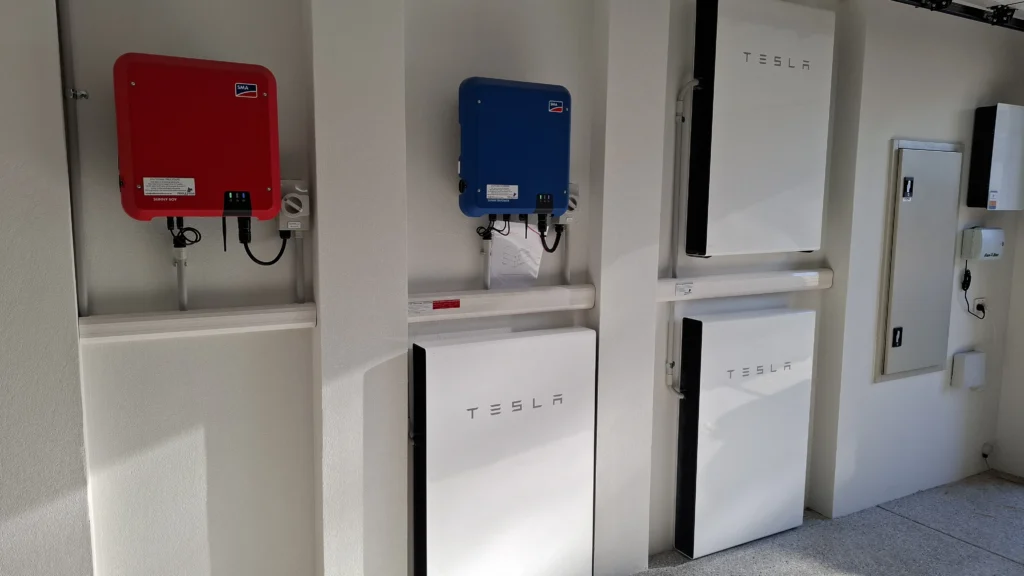
We are also certified Tesla Powerwall installers, and supply and install BYD and Sonnen batteries across Perth. Our installations start from $8,000 AUD.
Frequently Asked Questions
Which battery is best for Perth homes?
How much does a solar battery cost in Perth in 2026?
After the federal Cheaper Home Batteries Program rebate and the WA $1,300 rebate, most Perth households pay $7,000–$12,000 for a 10–13.5 kWh battery system depending on brand, inverter requirements, and site complexity. See our Solar Battery Cost Perth guide for a detailed breakdown.
Do solar batteries work during a blackout?
How long do solar batteries last?
Can I get a battery without solar panels?
How long does battery installation take?
Is a solar battery worth it in Perth in 2026?
