
The Tesla Powerwall 3 is one of Australia’s most popular home battery systems. With 13.5kWh of storage, a built-in hybrid inverter, whole-home backup capability, and the best monitoring app in the market, it suits Perth homeowners who want a premium, integrated solution that works seamlessly with their solar system.
Middle Swan Solar is a certified Tesla Powerwall installer in Perth. This page covers everything you need to know about the Powerwall 3. The specs, how it works in Perth, what it costs, and whether it’s the right battery for your home.
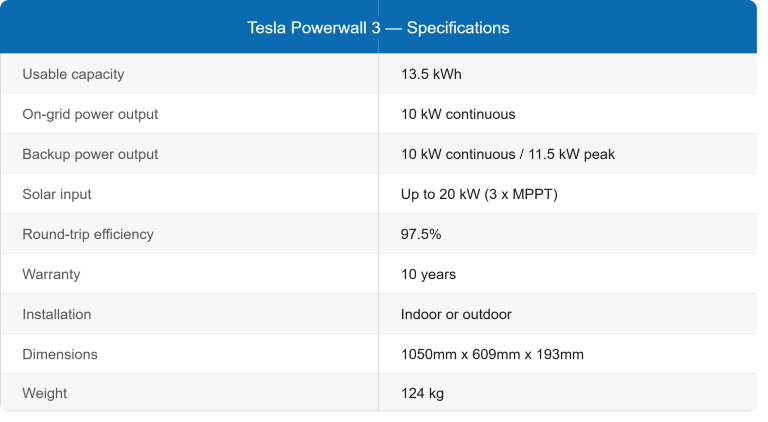
The Powerwall 3’s key differentiator from most competing batteries is its built-in hybrid solar inverter. Most batteries, including BYD and Sungrow, require a separate hybrid inverter to be purchased and installed alongside the battery. The Powerwall 3 includes this as part of the unit, which simplifies system design and in many cases reduces total installed solar battery cost when doing a new solar and battery installation together.
Perth’s electricity market makes battery storage particularly compelling compared to most other Australian states.
Under Synergy’s Distributed Energy Buyback Scheme, solar electricity exported to the grid earns only 2 cents per kWh between 9pm and 3pm, and 10 cents per kWh between 3pm and 9pm. The standard residential tariff for electricity imported from the grid is 32.37 cents per kWh.
This creates a clear financial case for a battery. Rather than exporting excess solar at 2 cents during the middle of the day, a Powerwall stores it and uses it in the evening when grid electricity would cost 32 cents. Each kilowatt-hour shifted from export to self-consumption is worth approximately 20–30 cents more.
The Powerwall 3 manages this automatically. You configure your preferences in the Tesla app. Charge from solar during the day, discharge in the evening, and the system handles the rest without manual intervention.
From 1 May 2026, new solar and battery systems in Perth’s SWIS grid must also meet updated WA technical rules including remote disconnection capability. The Powerwall 3 complies with these requirements as standard.
The Powerwall 2 is no longer available as a new product. If you are researching Tesla batteries in Perth, the Powerwall 3 is the current model. The two units are not compatible with each other — a Powerwall 3 cannot be added to an existing Powerwall 2 system.
The key differences for Perth buyers:
A fully installed Powerwall 3 in Perth including the mandatory Tesla Backup Gateway, standard wiring, and commissioning costs between $13,500 and $15,200 before rebates for a standard installation. Site-specific factors that affect cost include switchboard condition, cable run length, roof access, and whether a switchboard upgrade is required.
Federal rebate: The Australian Government’s Cheaper Home Batteries Program reduces the cost of a Powerwall 3 by approximately $3,367 for a single 13.5kWh unit. This rebate is applied at point of sale, you do not pay the full amount and claim back later.
WA state rebate: Synergy customers may be eligible for the $1,300 WA Residential Battery Scheme rebate, which stacks on top of the federal rebate.
After rebates: Most Perth households installing a single Powerwall 3 can expect an out-of-pocket cost of approximately $10,000–$11,800 for a standard installation.
For a full breakdown of what affects your quote and how to compare installers, see our Tesla Powerwall 3 price guide for Perth.
Because the Powerwall 3 has a built-in hybrid inverter, adding it to an existing solar system typically means replacing your existing string inverter with the Powerwall 3 unit. Your existing panels and racking stay in place.
This makes the Powerwall 3 one of the cleaner retrofit options available. For most Perth homes, it is a one-day installation. The tradeoff is that if your existing solar inverter is relatively new, you are effectively replacing a working unit.
If you have an older system or your existing inverter is approaching end of life, the Powerwall 3 retrofit makes strong financial sense. If your current inverter has several years of life remaining, other battery options that don’t require inverter replacement may be worth comparing.
Middle Swan Solar will assess your existing system and give you an honest recommendation before suggesting any work.
The Powerwall 3’s 10kW continuous backup output is the highest of any mainstream home battery available in Australia. This means it can run most whole-home loads simultaneously during a power outage, including ducted air conditioning, refrigeration, lighting, and general appliances.
Backup runtime depends on your usage. At modest load (lights, fridge, devices, approximately 1kW average) a single Powerwall 3 provides approximately 13–14 hours of backup. At higher load including air conditioning (approximately 2–3kW average) expect 4–7 hours.
Multiple Powerwall 3 units can be stacked for additional storage and extended backup time. This is particularly relevant for Perth Hills households who experience more frequent outages due to weather events.
The Powerwall 3 includes Storm Watch, a feature that automatically charges the battery to full when severe weather is forecast in your area, maximising backup power before an outage occurs.
The Tesla app is consistently rated as the best monitoring experience of any home battery in Australia. It provides real-time visibility of solar generation, battery state of charge, home consumption, and grid import and export, all in a clear, intuitive interface.
Key features relevant to Perth homeowners:
From not being able to see at night to losing all your food in the fridge, blackouts are always frustrating and inconvenient. It’s even more annoying if you work from home and lose internet connectivity, or your electric gates and garage stop functioning.
When the grid goes down, Tesla Powerwall powers up and saves the day. You’ve instantly got power where and when you need it. You can set it to power your whole house or select specific circuits to make your battery-stored power last even longer.
Tesla has also included a feature where you can set a minimum power reserve to ensure you always have something in the tank in the event of a blackout. This feature is especially popular for people who regularly experience blackouts, such as suburbs in the Perth Hills. These areas are often subject to strong weather conditions and fires, and experience more power outages as a result.
Absolutely. You can still get a Tesla Powerwall even if you don’t have solar panels. People often assume it only works with solar, but that’s not true at all. When there’s no solar system attached, the Powerwall simply charges from the grid and waits in the background. If there’s a blackout, it instantly kicks in and keeps your lights, fridge, and essential appliances running. So even without panels, it works like a modern, quiet, hassle-free backup generator that’s always ready when you need it.
For small to medium houses, certainly. If you have a very large home, you can easily stack (vertically or parallel) multiple Powerwalls to increase the backup and storage capacity. During your consultation, your installer can advise on how many Tesla inverters you’ll need.
Middle Swan Solar is a certified Tesla Powerwall installer in Perth.
Our installation team handles everything from system design and rebate applications through to commissioning and app setup. A standard Powerwall installation takes approximately four to six hours with two installers on site.
We service all Perth metro suburbs and surrounding regions including the Swan Valley, Perth Hills, and north and south of the river, areas where backup power is particularly valued given the frequency of weather-related outages.

The Powerwall 3 is Tesla’s current home battery system. It stores 13.5kWh of electricity, includes a built-in hybrid solar inverter, and provides up to 10kW of continuous backup power. It is the successor to the Powerwall 2 and is the only Tesla battery currently available as a new product in Australia.
At average household load of approximately 1kW, a single Powerwall 3 provides around 13–14 hours of backup. At higher loads including air conditioning, expect 4–7 hours. Multiple units can be stacked for extended backup.